Most boaters, marina operators, and procurement managers have heard the same promise for decades: “Don’t worry, it’s recyclable.” Yet when it comes to shrink wrap and other flexible films, that promise has rarely matched reality. For bioaqualife®, which exists to reduce plastic pollution rather than rebrand it, this gap between marketing and reality is exactly where the story needs to start.
The Center for Climate Integrity has unearthed internal industry documents showing that major fossil fuel and petrochemical companies have long known that plastic recycling is not technically or economically viable at scale, even as they promoted it as the primary solution to plastic waste. This history of “plastics deception” matters directly to shrink wrap users, because most marine and industrial shrink films are petrochemical products that end up in the same system those companies designed—and that system was never built to recover them.
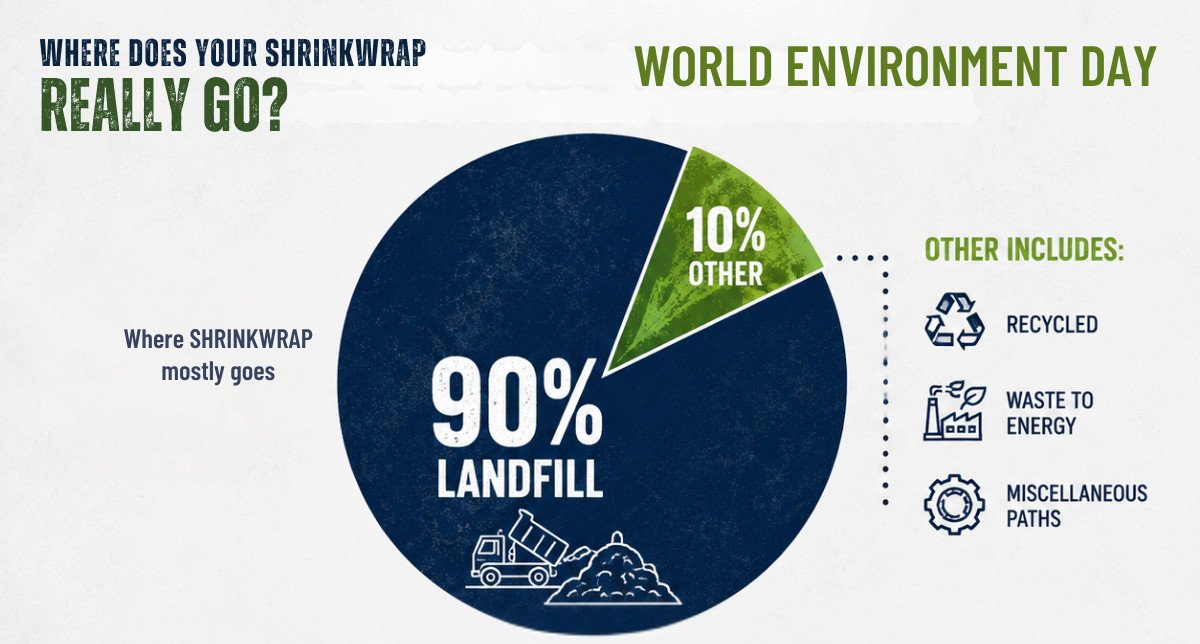
Before talking about alternatives, it is important to answer a simple, uncomfortable question: Where does shrink wrap really go?
The Hidden Journey of Shrink Wrap
Step 1: From “Recyclable” Logo to Trash Bag
On the surface, shrink wrap looks like an ideal candidate for recycling: it is thin, light, often made from a single polymer, and used in huge volumes. But in practice, post‑consumer shrink wrap rarely enters a true recycling stream.
For most marinas, boatyards, distributors, and warehouses, the path looks like this:
- Shrink wrap is cut off boats, pallets, or equipment at the end of a season or shipment.
- It is often dirty, wet, contaminated by the mold, mildew, mixed with straps, tape, labels, vents, and zippers.
- Staff may be told to “bag it for recycling,” but in many regions there is no infrastructure that can economically handle thin films at scale.
- The material ends up in general waste, where it is landfilled or incinerated.
The “chasing arrows” symbol—which many consumers interpret as proof of recyclability—has become so misleading that a large majority of U.S. voters now say it is deceptive when used on plastics that cannot actually be recycled in practice. Shrink wrap frequently sits in exactly that grey area: technically recyclable under perfect conditions, practically unrecycled in real life.
Step 2: Landfill, Incinerator, or Environment
Once discarded, shrink wrap has only a few destinations:
- Landfills: Thin films are lightweight but bulky, so they take up space while delivering little to no recovery value. In landfills, they persist for decades or longer.
- Incinerators or “waste‑to‑energy”: Burning shrink wrap releases greenhouse gases and can emit hazardous pollutants depending on additives and combustion controls.
- Leakage into the environment: Because shrink film is light and easily wind‑blown, it escapes collection sites, transfer stations, and landfills, ending up in waterways and coastal areas. Once there, it fragments into microplastics that can enter marine food webs.
The Center for Climate Integrity links this pattern of waste and pollution to a broader system: for decades, plastic producers expanded output while relying on a recycling narrative they knew would not work at scale. Shrink wrap is one of the clearest examples of that disconnect.
How the Recycling Narrative Failed Shrink Wrap
The Industry Knew the Limits
Internal documents from industry trade groups and major petrochemical companies show that, as early as the late 1980s and 1990s, insiders were warning that plastics recycling would not solve the growing waste problem.
Key themes in those documents and later analyses include:
- Technical barriers: Many plastics are hard to sort, contaminated in use, and degrade in quality each time they are reprocessed.
- Economic barriers: Collecting, cleaning, and processing post‑consumer plastics is often more expensive than producing virgin resin, especially for low‑value films like shrink wrap.
- Volume reality: Only a small fraction of plastic ever placed on the market has been recycled, and flexible films have some of the lowest recovery rates.
Despite this, the industry promoted recycling aggressively in advertising and public education campaigns, creating the impression that buying and using more plastic—so long as it carried a recycling symbol—was a responsible choice. Shrink wrap rode that wave: “recyclable” messaging made it easier to adopt for winter boat storage, pallet stabilization, and industrial protection without facing the full waste question.
“Advanced Recycling”: New Name, Same Problem
As concerns about plastic pollution grew and conventional recycling underperformed, petrochemical interests began promoting “advanced recycling” or chemical recycling as a high‑tech fix. The Center for Climate Integrity’s work shows that, once again, internal assessments paint a less optimistic picture:
- Many so‑called advanced recycling projects function primarily as plastic‑to‑fuel operations, turning waste plastic into feedstock that is ultimately burned rather than turned back into new plastic products.
- Industry consultants and trade associations have acknowledged significant technical and economic challenges, even as public messaging remains bullish.
For shrink wrap users, that means counting on a future chemical‑recycling solution is risky. The technology may remain niche, energy‑intensive, and focused on fuels rather than true circularity.
Why Shrink Wrap Is So Hard to Recycle in Practice
When trying to understand where shrink wrap goes, it helps to look at the practical barriers that make it such a difficult material in real waste systems.
- Collection logistics: Shrink wrap must be properly separated at the source, kept relatively clean and dry, and consolidated in large volumes to even be considered by most recyclers. Many marinas and small businesses cannot economically meet those conditions.
- Contamination: Tape, labels, straps, dirt, and biological growth from marine environments create contamination that drives up processing costs and lowers material value.
- Sorting and identification: Films can be made from different resins, and sorting them accurately is difficult in mixed streams.
- Low material value: Even when technically recyclable, thin films typically have low resale value compared to rigid plastics, so there is little economic incentive to build dedicated systems.
The result is a structural mismatch: a material that is widely used because it is cheap and convenient, funneled into waste systems that are not designed—or incentivized—to recover it. That is why, for the vast majority of users today, “Where does shrink wrap go?” still has the same answer: landfill, incinerator, or the environment.
From Deception to Responsibility: The Role of Truly Better Materials
Accountability Is Coming
Several U.S. states and local governments have already filed lawsuits against major fossil fuel and plastics companies over plastics deception, including claims focused specifically on false recycling promises.
Public opinion is shifting as well. Recent polling shows large majorities of voters believe the plastics and fossil fuel industries bear primary responsibility for the plastic waste crisis and support legal action to hold them accountable. The era of unquestioned “recyclable” branding is ending.
Why bioaqualife® Takes a Different Path
For companies like bioaqualife®, this moment is both a warning and an opportunity:
- It is a warning that simply labeling products as “recyclable” without a realistic, functioning recovery system is no longer acceptable.
- It is an opportunity to redefine what responsible shrink wrap and protective films look like, especially in marine and coastal applications where leakage into the environment is a constant risk.
In practice, that means focusing on:
- Materials and design that minimize long‑term persistence in the environment, especially in aquatic and coastal conditions, instead of assuming perfect collection and recycling.
- Transparency about end‑of‑life realities, including where products are likely to go today, not in a hypothetical ideal system.
- Partnerships with marinas, boatyards, and industrial users to redesign seasonal and logistical practices around waste reduction and safer materials, rather than simply shifting the burden downstream.
In other words, the question “Where does shrink wrap really go?” should drive product design, customer education, and policy advocacy—not be avoided in marketing.
Choosing Better: Questions Every Shrink Wrap User Should Ask
For marinas, boat owners, logistics managers, and sustainability teams, the new bar is not “Can we put a recycling logo on it?” but “What actually happens to this material when we are done with it?”
Some practical questions to ask any supplier or internal team include:
- Where does this specific shrink wrap go in our local system: landfill, incinerator, export or is there a documented, operational collection program?
- If it is called “recyclable,” can the supplier show that it is being recycled at scale, not just in small pilots?
- How does this material behave if it escapes into the environment, especially marine or coastal environments?
For a company like bioaqualife®, answering these questions honestly and designing products that account for real‑world conditions rather than idealized recycling narratives—is the foundation of genuine responsibility in the shrink wrap space.