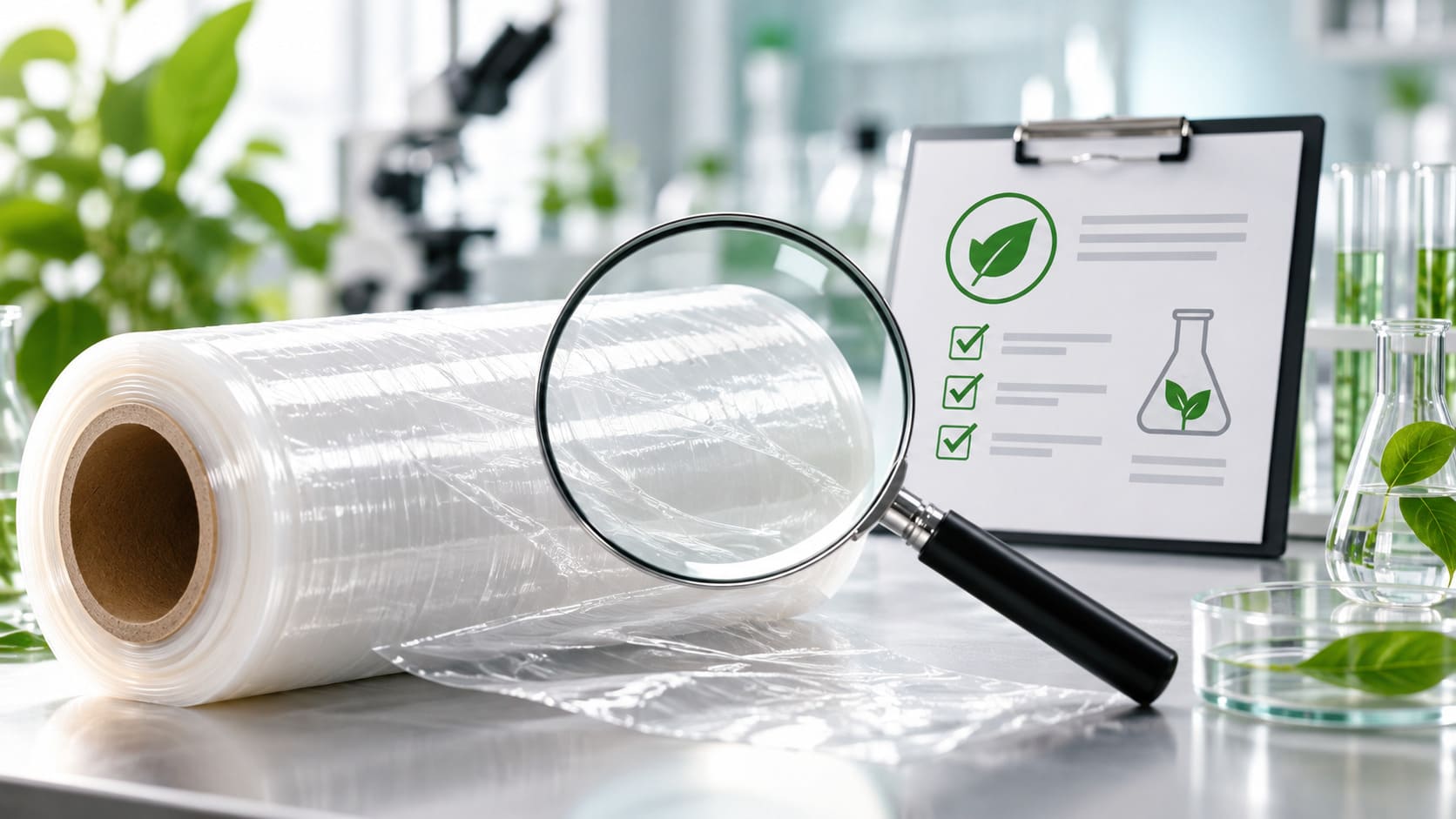
Quick answer: A biodegradable shrink wrap claim only holds up if it names a test standard (ASTM D5511 for landfill conditions), a specific result and timeframe, and comes from an independent, accredited lab report you can actually request and read. Not just a percentage on the packaging.
"Biodegradable" sells. It's on packaging, product pages, sales calls. Nobody checks what's behind the word. Most of the time, anyway.
That's the problem. "Biodegradable" isn't one fixed thing. It depends on where the material ends up, how it's tested, who's doing the testing. A claim with none of that behind it? Marketing copy. A claim with all of it? Something you can verify yourself.
The stakes are practical, not just semantic. Specify shrink wrap for a boatyard, a construction site, an industrial facility - and "biodegradable" might end up in a sustainability report. A customer conversation. A procurement policy. If the claim doesn't hold up later, that's your problem to explain. Not the supplier's.
Environmental marketing claims have drawn more scrutiny in recent years, too, well beyond plastics. Repeat an unverified supplier claim in your own marketing, and you can end up exposed to that same scrutiny - even though you never ran the test. Verify first. It protects the supplier's credibility, sure. It protects yours more.
Here's what to actually look for, in the order it usually comes up.
What "biodegradable" requires under FTC?
The FTC's Green Guides set the bar for environmental marketing claims in the US, biodegradability included. The core idea is simple: an unqualified "biodegradable" claim implies the product breaks down and returns to nature within a reasonably short time after customary disposal. About a year, per the FTC's own guidance, for most products thrown away the normal way.
Almost no plastic film clears that bar unqualified. So almost every legitimate biodegradability claim on shrink wrap needs qualification. Not vague. Not implied. Specific. A qualified claim names the actual conditions the product was tested under - landfill, marine, composting are not interchangeable. It names the actual timeframe too. "Biodegradable in landfill conditions, verified over 1,130 days" is a qualified claim. "Biodegradable," printed alone on a roll of film, is not.
Why does the distinction exist? Because the alternative misleads by omission. Read "biodegradable" with no qualification, and you have every reason to assume it means what the word normally means: breaks down naturally, reasonably fast, wherever it ends up. Usually not true for plastic film. So the claim has to say what actually happens, and under what conditions.
Qualification isn't a loophole. Suppliers don't use it to soften a weak claim - it's the opposite. It's what makes a claim honest instead of aspirational. Name conditions and a timeframe, and you're telling buyers you actually tested the product. And you're willing to stand behind the specifics.
A qualified claim reads like a data point, not a slogan: material, standard, result, duration, all named together. Longer than "biodegradable shrink wrap" on its own. Supposed to be. The extra length is the qualification doing its job. Strip a claim down to one unqualified word without losing meaning, and it probably wasn't saying much to begin with.
What ASTM D5511 actually measures?
For plastics headed to a landfill, the relevant test is ASTM D5511 - the standard method for measuring anaerobic biodegradation of plastic materials in a high-solids environment, built to simulate landfill conditions. Different animal from tests built around aerobic composting, which assume oxygen, moisture, microbial activity a sealed landfill doesn't have. A film tested for composting hasn't been tested for landfill biodegradation. The two results aren't interchangeable. A claim should say which one it's making.
The mechanism is gas. Microorganisms break the material down, release methane and carbon dioxide as they go. The lab measures that gas output over the test period and compares it to the theoretical maximum the material could produce if it fully converted. The result comes back as a percentage of biodegradation at a specific number of days. Not a percentage of "how eco-friendly" something is.
What the result does and doesn't tell you:
One sample, one timeframe
ASTM D5511 tells you what happened to a specific sample, under specific conditions, over a specific timeframe. It doesn't tell you what happens on a shelf, in a warehouse, or in the ocean.
Not a promise, a data point
A result at 1,130 days isn't a guarantee the material fully disappears by that date, and it isn't a projection of what happens afterward. It's a measured figure: this much biodegradation happened, by this day of testing.
No test shows a clean 100%
Some residual mass, moisture, and gas remain even in strong-performing materials. A result in the high 70s or 80s percent range, properly documented, usually reflects genuine performance, not a shortfall.
Duration changes what the number means
Labs report results at different points along the curve, some after a few hundred days, others past a thousand. A 80.2% result at 1,130 days isn't directly comparable to a different percentage at a different interval unless the day count is stated alongside it.
What a real third-party report looks like?
The only claim worth trusting ties to a named, third-party test standard. For landfill conditions, that's ASTM D5511 - anaerobic microbial breakdown, measured over a defined period. A film tested under D5511 with a published incubation period of 1,130 days (just over three years) and a disclosed methodology, not just a headline number, is making a fundamentally different claim than one that just prints "eco-friendly" on the roll. In bioWRAP®'s case, that testing reached 80.2% biodegradation under simulated landfill conditions; actual results in real-world environments vary with temperature, moisture, and waste composition.
A real report comes from an independent lab. Not the manufacturer's own testing. It names the standard, the test duration, the sample tested. It's available on request - not summarized into a single number with no way to check the work behind it.
Beyond the headline figure, a complete report typically includes:
- Lab name and accreditation - who ran the test, and to what quality standard
- Exact test method and version - e.g., ASTM D5511, with the specific edition cited
- Sample description - material, thickness, size of the tested specimen
- Test start and end dates - so the duration is verifiable, not just stated
- Raw data - gas volumes, sample mass, calculation methodology, in enough detail that another lab could in principle reproduce the analysis
A one-line summary with a percentage and nothing else isn't a report. It's a quote from one.
Accreditation deserves a mention of its own. Easy to check. Easy for a marketing claim to skip. Independent testing labs are typically accredited to recognized quality standards - ISO/IEC 17025 is the common one for testing and calibration labs generally. Their processes get reviewed by a third party, not just self-certified. A report from an accredited lab, with the accreditation stated, carries more weight than one from a lab nobody can verify.
Watch for one more thing. Some reports include an additional adjusted or extrapolated figure alongside the raw, as-tested result - often based on an assumption about how a reference material would behave under ideal conditions. Not wrong to disclose. But it isn't the ASTM D5511 result either. Quote only the higher, adjusted figure and skip the raw one? Ask about it. The raw, as-tested percentage is the number a regulator wants to see first. Or a skeptical customer.
Hesitate to share the report, or promise to "send it later" and never follow through - that tells you something. A supplier with a real, published report generally doesn't mind sharing it. It's the strongest piece of marketing they have.
Red flags: a claim without a report or a standard
Some suppliers claim biodegradability without publishing a third-party report or naming a standard at all. That's the clearest red flag there is. A real claim has a paper trail. A marketing claim doesn't need one.
|
Red flag |
Why it matters |
|
No test standard named |
There's no way to know what was actually measured, or under what conditions |
|
No independent lab named |
Self-reported results aren't verified by anyone outside the company |
|
"100% biodegradable" |
Biodegradation testing never shows a clean 100% - some residual mass, gas, and moisture is normal even in a fully successful test |
|
No timeframe given |
"Biodegradable" with no duration attached could mean anything from months to centuries |
|
Report "available on request" that never arrives |
If a supplier can't produce the report when asked, the claim isn't verifiable |
|
Vague terms without a standard behind them |
"Eco-friendly," "green," or "sustainable" used interchangeably with "biodegradable" usually signals marketing language, not a tested claim |
|
Conditions left unspecified |
A claim that doesn't say landfill, marine, or composting is a claim that hasn't committed to anything testable |
None of this means a product definitely isn't biodegradable. It means the claim, as presented, isn't something a buyer can verify. And an unverifiable claim isn't something to build a sustainability decision on.
Here's the catch, though: a supplier can clear every item on this list and still make a claim that's technically true but practically irrelevant to your use case. A landfill result says nothing about marine performance. A supplier isn't obligated to volunteer that distinction. Read the conditions a test actually ran under - that matters just as much as confirming the test happened at all.
Practical takeaway: before buying, ask for the test standard, the lab name, and the report itself - not just the headline percentage. Can't produce all three? Treat the claim as unverified.
How bioaqualife tests?
bioaqualife runs its bioWRAP® film through exactly this kind of testing, with an incubation period of 1,130 days (just over three years) under ASTM D5511 conditions. Under these conditions, the material reached 80.2% biodegradation; actual results in real-world landfill environments vary with temperature, moisture, and waste composition. The test results are available for anyone who wants to check the methodology instead of taking the headline figure on faith.
Biodegradation is only part of the picture, too, for a buyer weighing a purchase decision. Alongside the ASTM D5511 result, bioWRAP® is separately documented for:
- UV stability - for extended outdoor use without breaking down in service
- Weldability - welds cleanly with standard heat-sealing equipment, no special tools required
- Microplastic residue - none, per the same third-party testing
- Fire performance - ASTM E84 Class A and EN 13501-1 B-s1,d0, separate standards with their own named classifications
None of that shows up in a biodegradation percentage. But it affects whether the film performs on the job, long before it ever reaches a landfill. Document every performance claim the same way - standard by standard, not adjective by adjective - and that's a supplier treating verification as routine. Not optional.
Evaluating shrink wrap for a marine, construction, transportation, or industrial application, with biodegradability part of the decision? Start with the report. Not the packaging copy. Review bioWRAP®'s full specifications, or go straight to the ASTM D5511 test report and methodology to see exactly what was tested and how.