Last updated: November 13, 2026
Quick answer: Most boat shrink wrap ends up in a landfill after removal, since it is rarely accepted in curbside recycling. Some marinas offer collection for bulk recycling where a program exists. Biodegradable films like bioWRAP® are designed to break down through microbial action in landfill conditions rather than persist indefinitely.
Where Does Removed Shrink Wrap Actually Go?
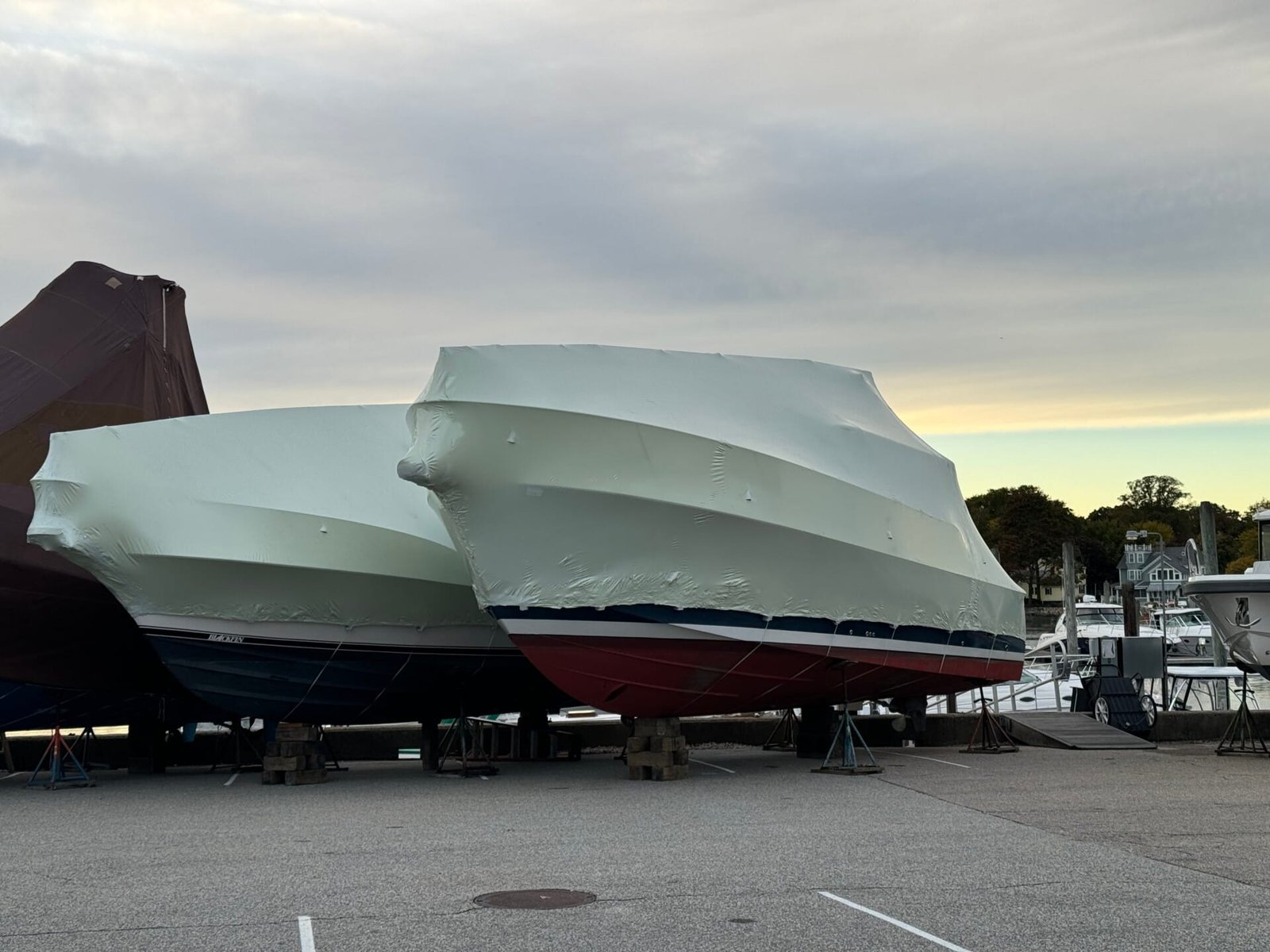
Shrink wrap comes off in spring, usually in one piece or a few large sections, and then someone has to deal with it. For most boat owners, that means a trash bag and a landfill. It is bulky, it is not curbside-recyclable in nearly any municipality, and most marinas do not have a dedicated collection stream for it.
A smaller number of marinas and marine supply chains run bulk collection programs for shrink wrap film, baling it for recycling through a specialty processor rather than general waste. These programs exist in pockets, not nationwide, and whether one is available depends entirely on your region and your marina.
Even where a program exists, the film itself is the main obstacle. After a season outdoors it comes off covered in dirt and sand, and it often carries paint residue (especially if it was used as a tent during painting), sticky tape, vent grilles, other hardware and mildew. To be accepted by a recycling facility, it has to be thoroughly cleaned and prepared to that facility's requirements, and that preparation is very expensive in labor. This is why boat film so often ends up in the trash anyway.
Why Curbside Recycling Doesn't Work for Shrink Wrap
Standard curbside recycling bins are built for rigid containers like bottles and jugs, sorted by machines that are not set up to handle large, thin plastic film. Film gets tangled in sorting equipment and contaminates other recyclables, which is why most residential recycling programs explicitly exclude it.
Film recycling, when it happens, runs through separate collection streams designed for that material, often through drop-off programs rather than curbside pickup. The Association of Plastic Recyclers tracks which film types are accepted through these specialty channels and under what conditions.
Is Recycling a Realistic Option for Boat Shrink Wrap?
Recycling often gets offered as the answer for used shrink wrap, and that is part of the problem. Boat owners are told their wrap goes to recycling, which gives them peace of mind, but few owners or marinas can say where the film actually goes or how much of it is ever recycled.
bioWRAP® is LDPE-based (resin code 4) and can be recycled with other LDPE film where a local program accepts it, but bioaqualife® does not position recycling as the end-of-life route for its shrink wrap. bioWRAP® is designed for disposal with regular solid waste, so there is no extra sorting or cleaning step.
Its ongoing independent ASTM D5511 test has run for 1,130 days under simulated landfill conditions, and the material has reached 80.2% biodegradation. Actual results in real-world landfills vary with temperature, moisture and waste composition.
The practical obstacles are real. Used boat film is dirty, wet and taped, and recyclers want it clean and dry. Collection points are few. Even where a program exists, someone has to clean and sort the film first, and that labor lands on the marina or the owner.
Disposal Paths Compared
| Disposal Path | Availability | What Happens to the Film |
|---|---|---|
| Landfill (standard trash) | Universally available | Film is buried; biodegradable film breaks down via microbial action over time, conventional film persists |
| Marina bulk collection | Limited, region-dependent | Baled and sent to a film recycling processor, if a local program exists |
| Incineration (waste-to-energy) | Available in some municipalities | Film is combusted along with other municipal waste |
| Curbside recycling | Not available for shrink wrap | Not accepted; film is a contaminant in standard recycling streams |
What Happens to bioWRAP® Specifically
Separately from any collection program, bioWRAP® is engineered to biodegrade through microbial consumption once it reaches landfill conditions. The breakdown is driven by microbial metabolism rather than physical fragmentation.
Independent ASTM D5511 testing is ongoing. After an incubation period of 1,130 days under simulated landfill (anaerobic, high-solids) conditions, the material reached 80.2% biodegradation, verified by an independent third-party lab (Eden Research Laboratory). That testing reflects accelerated lab conditions; actual results in a real landfill will vary with temperature, moisture and the surrounding waste composition. The full ASTM D5511 test report documents the methodology and results in detail.
Why the Breakdown Mechanism Matters
Not every film that disappears from view has actually broken down. Some films fragment under UV exposure and mechanical stress into smaller and smaller pieces, but the plastic itself is still there.
bioWRAP® works differently. Its breakdown is driven by microbial metabolism rather than physical fragmentation. That is why a landfill biodegradation result and a film that simply falls apart are not the same thing.
What You Can Do With Removed Film Right Now
A few practical steps make spring removal cleaner, whichever film is on your boat:
- Ask who collects it and where it goes. Many owners assume film sent for recycling is recycled and never ask. A direct question to your marina or hauler shows what really happens to it.
- Take off non-film parts first. Vents, straps, tape and the zipper door come off before the film is bagged, so the hauler gets film and not a tangle of hardware.
- Bag it as it comes off. Loose film blows across the lot and ends up in the harbor.
- Never burn it. Open burning of plastic film releases pollutants and is restricted or banned in many areas; use municipal disposal instead.
Practical takeaway: before sending removed shrink wrap anywhere, ask whoever collects it how much of it is actually recycled; if the answer is vague, standard solid waste disposal is a legitimate and often more realistic option.
Choosing a film that is documented for landfill biodegradation, like bioWRAP®, does not eliminate the disposal question, but it does change what happens to the material once it is buried rather than how it gets there. For boat owners deciding between materials before the next wrap job, how much it costs to shrink wrap a boat and whether to do it yourself or hire a pro are the two questions that usually come up first.
Frequently Asked Questions
Can boat shrink wrap be recycled?
Is it illegal to throw away boat shrink wrap?
Does biodegradable shrink wrap still need to go to a landfill?
Can bioWRAP® be recycled?